Term Describing the Influence of Japanese Art Fashion and Aesthetics on Western Culture?

Young Ladies Looking at Japanese Objects past the painter James Tissot in 1869 is a representation of the popular curiosity near all Japanese items that started with the opening of the country in the Meiji Restoration of the 1860s.
Japonisme [a] is a French term that refers to the popularity and influence of Japanese art and design among a number of Western European artists in the nineteenth century post-obit the forced reopening of foreign trade with Nihon in 1858.[one] [2] Japonisme was first described by French art critic and collector Philippe Burty in 1872.[iii]
While the effects of the trend were likely most pronounced in the visual arts, they extended to architecture, landscaping and gardening, and wearable.[4] Even the performing arts were affected; Gilbert & Sullivan's The Mikado is perhaps the all-time example.
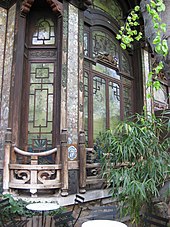
Window of La Pagode (Paris), congenital in 1896
From the 1860s, ukiyo-east, Japanese woodblock prints, became a source of inspiration for many Western artists.[5] These prints were created for the commercial market in Japan.[5] Although a pct of prints were brought to the West through Dutch merchandise merchants, it was not until the 1860s that ukiyo-east prints gained popularity in Europe.[5] Western artists were intrigued by the original apply of color and composition. Ukiyo-e prints featured dramatic foreshortening and asymmetrical compositions.[6]
Japanese decorative arts, including ceramics, enamels, metalwork, and lacquerware, were as influential in the Due west equally the graphic arts.[vii] During the Meiji era (1868–1912), Japanese pottery was exported around the globe.[8] From a long history of making weapons for samurai, Japanese metalworkers had achieved an expressive range of colours past combining and finishing metal alloys.[ix] Japanese cloissoné enamel reached its "golden age" from 1890 to 1910,[ten] producing items more advanced than ever before.[11] These items were widely visible in nineteenth-century Europe: a succession of world's fairs displayed Japanese decorative fine art to millions,[12] [xiii] and it was picked upward by galleries and fashionable stores.[seven] Writings past critics, collectors, and artists expressed considerable excitement most this "new" art.[vii] Collectors including Siegfried Bing[14] and Christopher Dresser[fifteen] displayed and wrote nigh these works. Thus Japanese styles and themes reappeared in the work of Western artists and craftsmen.[vii]
History [edit]
Seclusion (1639–1858) [edit]
During the most of the Edo menstruum (1603–1867), Japan was in a time of seclusion and only one international port remained active.[xvi] Tokugawa Iemitsu ordered that an island, Dejima, exist congenital off the shores of Nagasaki from which Nihon could receive imports.[16] The Dutch were the only Westerners able to engage in trade with the Japanese, yet this modest amount of contact even so allowed for Japanese art to influence the W.[17] Every year the Dutch arrived in Nihon with fleets of ships filled with Western appurtenances for trade.[18] The cargo included many Dutch treatises on painting and a number of Dutch prints.[18] Shiba Kōkan (1747–1818) was one of the Japanese artists that studied the imports.[xviii] Kōkan created one of the first etchings in Japan which was a technique he had learned from one of the imported treatises.[eighteen] Kōkan combined the technique of linear perspective, which he learned from a treatise, with his ain ukiyo-e styled paintings.

Early exports [edit]
The primary Japanese exports were initially silver, which was prohibited after 1668, and gold, more often than not in the course of oval coins, which was prohibited afterward 1763, and later copper in the form of copper bars. Japanese exports somewhen decreased and shifted to craftwork such as ceramics, hand fans, paper, furniture, swords, armors, mother-of-pearl objects, folding screens, and lacquerware, which were already being exported.[nineteen]
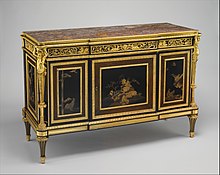
During the era of seclusion, Japanese goods remained a luxury sought after by European elites.[20] The production of Japanese porcelain increased in the seventeenth century, after Korean potters were brought to the Kyushu surface area.[21] The immigrants, their descendants, and Japanese counterparts unearthed kaolin clay mines and began to brand high quality pottery. The alloy of traditions evolved into a distinct Japanese industry with styles such as Imari ware and Kakiemon. They would after influence European and Chinese potters.[20] The exporting of porcelain was further boosted by the effects of the Ming-Qing transition, which immobilized the center of Chinese porcelain production in Jingdezhen for several decades. Japanese potters filled the void making porcelain for European tastes.[20] Porcelain and lacquered objects became the chief exports from Japan to Europe.[22] An extravagant mode to display porcelain in a dwelling house was to create a porcelain room with shelves placed throughout to prove off the exotic wares,[22] but the buying of a few pieces was possible for a wide and increasing social range of the middle class. Marie Antoinette and Maria Theresa are known collectors of Japanese lacquerware, and their collections are oftentimes exhibited in the Louvre and the Palace of Versailles.[23] The European simulated of Asian lacquerwork is referred to every bit Japanning.[24]
Re-opening (19th century) [edit]
During the Kaei era (1848–1854), later more than 200 years of seclusion, foreign merchant ships of various nationalities began to visit Nihon. Following the Meiji Restoration in 1868, Japan ended a long period of national isolation and became open to imports from the Due west, including photography and press techniques. With this new opening in trade, Japanese art and artifacts began to appear in pocket-sized marvel shops in Paris and London.[25] Japonisme began as a craze for collecting Japanese art, especially ukiyo-e. Some of the first samples of ukiyo-due east were seen in Paris.[26]
During this time, European artists were seeking alternatives to the strict European bookish methodologies.[27] Effectually 1856, the French artist Félix Bracquemond encountered a re-create of the sketch book Hokusai Manga at the workshop of his printer, Auguste Delâtre.[28] In the years following this discovery, there was an increment of interest in Japanese prints. They were sold in curiosity shops, tea warehouses, and larger shops.[28] Shops such as La Porte Chinoise specialized in the sale of Japanese and Chinese imports.[28] La Porte Chinoise, in particular, attracted artists James Abbott McNeill Whistler, Édouard Manet, and Edgar Degas who drew inspiration from the prints.[29] It and other shops organized gatherings which facilitated the spread of information regarding Japanese art and techniques.[27]
Artists and Japonisme [edit]
Ukiyo-e prints were one of the chief Japanese influences on Western art. Western artists were inspired by different uses of compositional infinite, flattening of planes, and abstract approaches to colour. An emphasis on diagonals, asymmetry, and negative space can be seen in the works of Western artists who were influenced by this style.[30]
Vincent van Gogh [edit]
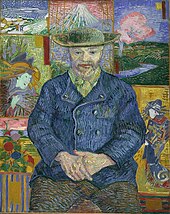
Vincent van Gogh'south interest in Japanese prints began when he discovered illustrations past Félix Régamey featured in The Illustrated London News and Le Monde Illustré. [31] Régamey created woodblock prints, followed Japanese techniques, and oftentimes depicted scenes of Japanese life.[31] Van Gogh used Régamey as a reliable source for the creative practices and everyday scenes of Japanese life. Beginning in 1885, Van Gogh switched from collecting magazine illustrations, such equally Régamey, to collecting ukiyo-e prints which could exist bought in small-scale Parisian shops.[31] He shared these prints with his contemporaries and organized a Japanese print exhibition in Paris in 1887.[31]
Van Gogh's Portrait of Père Tanguy (1887) is a portrait of his color merchant, Julien Tanguy. Van Gogh created two versions of this portrait. Both versions feature backdrops of Japanese prints[32] past identifiable artists similar Hiroshige and Kunisada. Inspired by Japanese woodblock prints and their colorful palettes, Van Gogh incorporated a similar vibrancy into his own works.[33] He filled the portrait of Tanguy with vibrant colors as he believed that buyers were no longer interested in grayness-toned Dutch paintings and that paintings with many colors would be considered modern and desirable.[33]
Alfred Stevens [edit]
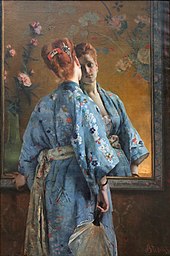
The Belgian painter Alfred Stevens was one of the earliest collectors and enthusiast of Japanese art in Paris.[34] [35] Objects from Stevens' studio illustrate his fascination with Japanese and exotic knick-knacks and furniture. Stevens was close with Manet and to James McNeill Whistler,[36] with whom he shared this interest early on. Many of his contemporaries were similarly enthused, especially after the 1862 International Exhibition in London and the International Exposition of 1867 in Paris, where Japanese fine art and objects appeared for the first time.[36]
From the mid-1860's, Japonisme became a fundamental element in many of Stevens' paintings. I of his well-nigh famous Japonisme-influenced works is La parisienne japonaise (1872). He realized several portraits of young women dressed in kimono, and Japanese elements feature in many other paintings of his, such as the early on La Dame en Rose (1866), which combines a view of a fashionably dressed adult female in an interior with a detailed exam of Japanese objects, and The Psyché (1871), wherein on a chair there sit Japanese prints, indicating his creative passion.[37]
Edgar Degas [edit]
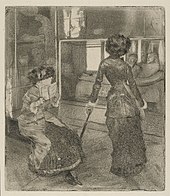
Edgar Degas, Mary Cassatt at the Louvre: The Etruscan Gallery, 1879–1880. Aquatint, drypoint, soft-footing carving, and carving with burnishing, 26.viii × 23.6 cm.
In the 1860s, Edgar Degas began to collect Japanese prints from La Porte Chinoise and other pocket-sized impress shops in Paris.[38] His contemporaries had begun to collect prints likewise, which gave him a wide array of sources for inspiration.[38] Among prints shown to Degas was a re-create of Hokusai's Manga, which Bracquemond had purchased after seeing it in Delâtre'southward workshop.[27] The estimated date of Degas' adoption of japonismes into his prints is 1875, and information technology can be seen in his option to divide individual scenes by placing barriers vertically, diagonally, and horizontally.[38]
Similar to many Japanese artists, Degas' prints focus on women and their daily routines.[39] The atypical positioning of his female person figures and the dedication to reality in his prints aligned him with Japanese printmakers such as Hokusai, Utamaro, and Sukenobu.[39] In Degas' impress Mary Cassatt at the Louvre: The Etruscan Gallery (1879–80), the creative person uses of two figures, ane seated and one continuing, which is a mutual composition in Japanese prints.[40] Degas besides continued to apply lines to create depth and separate space within the scene.[twoscore] His most clear appropriation is of the adult female leaning on a airtight umbrella, which is borrowed directly from Hokusai's Manga.[41]
James McNeill Whistler [edit]
Japanese art was exhibited in Britain first in the early 1850s.[42] These exhibitions featured various Japanese objects, including maps, letters, textiles, and objects from everyday life.[43] These exhibitions served equally a source of national pride for Great britain and served to create a divide Japanese identity autonomously from the generalized "Orient" cultural identity.[44]
James Abbott McNeill Whistler was an American artist who worked primarily in United kingdom of great britain and northern ireland. During the late 19th century, Whistler began to reject the Realist style of painting that his contemporaries favored. Instead, he found simplicity and technicality in the Japanese aesthetic.[45] Rather than copying specific artists and artworks, Whistler was influenced past general Japanese methods of articulation and composition, which he integrated into his works.[45]
Artists influenced by Japanese art and civilization [edit]
| Creative person | Date of birth | Engagement of death | Nationality | Style |
|---|---|---|---|---|
| Alfred Stevens | 1823 | 1906 | Belgian | Realism, Genre painting |
| James Tissot | 1836 | 1902 | French | Genre Fine art, Realism |
| James McNeill Whistler | 1834 | 1903 | American | Tonalism, Realism, Impressionism |
| Édouard Manet | 1832 | 1883 | French | Realism, Impressionism |
| Claude Monet | 1840 | 1926 | French | Impressionism |
| Vincent van Gogh | 1853 | 1890 | Dutch | Post-Impressionism |
| Edgar Degas | 1834 | 1917 | French | Impressionism |
| Pierre-Auguste Renoir | 1841 | 1919 | French | Impressionism |
| Camille Pissarro | 1830 | 1903 | Danish-French | Impressionism, Postal service-Impressionism |
| Paul Gauguin | 1848 | 1903 | French | Mail-Impressionism, Primitivism |
| Henri de Toulouse-Lautrec | 1864 | 1901 | French | Post-Impressionism, Art Nouveau |
| Mary Cassatt | 1844 | 1926 | American | Impressionism |
| George Hendrik Breitner | 1857 | 1923 | Dutch | Amsterdam Impressionism |
| Bertha Lum | 1869 | 1954 | American | Japanese Styled Prints |
| William Bradley | 1801 | 1857 | English | Portrait |
| Aubrey Beardsley | 1872 | 1898 | English | Art Nouveau, Aestheticism |
| Arthur Wesley Dow | 1857 | 1922 | American | Craft Revival, Japanese Styled Prints |
| Alphonse Mucha | 1860 | 1939 | Czech | Art Nouveau |
| Gustav Klimt | 1862 | 1918 | Austrian | Art Nouveau, Symbolism |
| Pierre Bonnard | 1867 | 1947 | French | Post-Impressionism |
| Frank Lloyd Wright | 1867 | 1959 | American | Prairie School |
| Charles Rennie Mackintosh | 1868 | 1928 | Scottish | Symbolism, Arts and crafts, Art Nouveau, Glasgow Fashion |
| Louis Comfort Tiffany | 1848 | 1933 | American | Jewelry and drinking glass designer |
| Helen Hyde | 1868 | 1919 | American | Japanese Styled Prints |
| Georges Ferdinand Bigot | 1860 | 1927 | French | Cartoon |
Theater [edit]
The first popular stagings of Asia were depictions of Japan from England. The comic opera Kosiki (originally titled The Mikado simply renamed after protest from Nippon) was written in 1876. In 1885, Gilbert and Sullivan, apparently less concerned about Japanese perceptions, premiered their Mikado. This comic opera enjoyed immense popularity throughout Europe where seventeen companies performed it 9,000 times within two years of its premiere. Translated into German in 1887, The Mikado remained the almost popular drama in Federal republic of germany throughout the 1890s. In the wake of this popularity, comedies set in Asia and featuring comic Asian figures appeared in rapid succession, both in comic opera and drama.
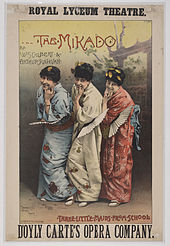
Advertising affiche for the comic opera The Mikado, which was set in Japan (1885)
The successor to The Mikado as Europe's near popular Nippon drama, Sidney Jones' opera The Geisha (1896) added the championship character to the stock characters representing Nippon, the figure of the geisha belongs to the "objects " which in and of themselves meant Japan in Germany and throughout the W. The flow from 1904 to 1918 saw a European boom in geisha dramas. The nearly famous of these was, of course, Puccini's opera Madama Butterfly. In 1900, Puccini saw a staging of David Belasco'southward play of the same name and reportedly found it and then moving that he wept. The popularity of the opera brought on a slew of Madame Something or Others, including Madames Cherry, Espirit, Flott, Flirt, Wig-Wag, Leichtsinn, and Tip Acme, all of whom appeared around 1904 and disappeared relatively apace. They were not without lasting effect, however, and the geisha had established herself amidst the scrolls, jade, and images of Mountain Fuji that signified Japan to the West. Much as this man figure of the geisha was reduced to the level of other objects signifying ing Japan in the drama, Japanese performers in Federal republic of germany served German play wrights in their quest to renew the German drama. But every bit ukiyo-e had proven useful in France, severed from whatsoever understanding of Nihon, the troupes of Japanese actors and dancers that toured Europe provided materials for "a new way of dramatizing"on stage. Ironically, the popularity and influcnce of these Japanese dramas had a not bad deal to practice with the westernization of the Japanese theater in general and of the pieces performed in Europe in item.
Invented for the Kabuki theatre in Nihon in the 18th century, the revolving stage was introduced into Western theater at the Residenz theatre in Munich in 1896 nether the influence of japonism fever. The Japanese influence on High german drama first appeared in stage design. Karl Lautenschlager adopted the Kabuki revolving stage in 1896 and ten years later Max Reinhardt employed it in the premiere of Frühlings Erwachen by Frank Wedekind. Soon this revolving stage was a trend in Berlin. Another adaptation of the Kabuki phase pop among German directors was the Blumensteg, a jutting extension of the phase into the audition. The European associate with Kabuki came either from travels in Japan or from texts, merely also from Japanese troupes touring Europe. In 1893, Kawakami Otojiro and his troupe of actors arrived in Paris, returning again in 1900 and playing in Berlin in 1902. Kawakami's troop performed two pieces, Kesa and Shogun, both of which were westernized and were porformed without music and with the majority of the dialogue climinated. This being the case, these performances tended toward pantomime and trip the light fantastic toe. Dramatists and critics chop-chop latched on to what they saw every bit a"re-theatricalization of the theater." Among the actors in these plays was Sada Yacco, outset Japanese star in Europe, who influenced pioneers of modern trip the light fantastic such as Loie Fuller and Isadora Duncan, she performed for Queen Victoria in 1900, and enjoyed the status of a European star.[46] [47]
Japanese gardens [edit]
The artful of Japanese gardens was introduced to the English language-speaking world by Josiah Conder's Landscape Gardening in Japan (Kelly & Walsh, 1893), which sparked the first Japanese gardens in the West. A second edition was published in 1912.[48] Conder's principles have sometimes proved hard to follow:[ commendation needed ]
Robbed of its local garb and mannerisms, the Japanese method reveals aesthetic principles applicative to the gardens of any land, teaching, every bit it does, how to convert into a verse form or picture a composition, which, with all its variety of detail, otherwise lacks unity and intent.[49]
Tassa (Saburo) Eida created several influential gardens, two for the Japan–British Exhibition in London in 1910 and one built over four years for William Walker, 1st Baron Wavertree.[50] The latter tin nevertheless be visited at the Irish National Stud.[51]
Samuel Newsom'due south Japanese Garden Construction (1939) offered Japanese aesthetics as a corrective in the construction of rock gardens, which owed their quite split origins in the West to the mid-19th century want to grow alpines in an approximation of Alpine scree. According to the Garden History Lodge, Japanese landscape gardener Seyemon Kusumoto was involved in the development of around 200 gardens in the United kingdom. In 1937, he exhibited a rock garden at the Chelsea Flower Testify, and worked on the Burngreave Estate at Bognor Regis, a Japanese garden at Cottered in Hertfordshire, and courtyards at Du Cane Court in London.
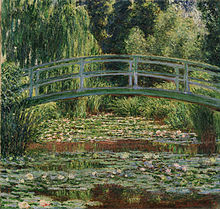
The impressionist painter Claude Monet modelled parts of his garden in Giverny later on Japanese elements, such as the span over the lily pond, which he painted numerous times. In this series, by detailing just on a few select points such as the span or the lilies, he was influenced by traditional Japanese visual methods found in ukiyo-e prints, of which he had a large collection.[52] [53] [54] He also planted a large number of native Japanese species to give information technology a more than exotic feeling.
Museums [edit]
In the United States, the fascination with Japanese art extended to collectors and museums creating significant collections which still exist and accept influenced many generations of artists. The epicenter was in Boston, likely due to Isabella Stewart Gardner, a pioneering collector of Asian fine art.[55] As a result, the Museum of Fine Arts, Boston at present claims to house the finest collection of Japanese fine art exterior Japan.[56] The Freer Gallery of Art and the Arthur M. Sackler Gallery business firm the largest Asian art research library in the United States, where they house Japanese art together with the Japanese-influenced works of Whistler.
Gallery [edit]
-

-

-
-

-

Japanese salon at Villa Hügel, Vienna
-

Meet also [edit]
- Anglo-Japanese manner
- Arabist – "Arab" style
- Chinoiserie – similar Chinese influence on Western fine art and design
- David B. Gamble House
- Occidentalism – for Eastern views of the Westward
- Orientalism – Western romanticized depictions of Asian (more oft Near Eastern) subject matter
- Turquerie
- Woodblock printing in Japan
- Woodcut
- Yamashiro Historic District
Notes [edit]
- ^ From the French Japonisme
References [edit]
- References
- ^ "Japonism". The Free Dictionary. Retrieved 7 June 2013.
- ^ "Commodore Perry and Japan (1853–1854) | Asia for Educators | Columbia University". afe.easia.columbia.edu . Retrieved 2020-02-02 .
- ^ Ono 2003, p. 1
- ^ Davis, Aaron, "Japanese Influence On Western Architecture Part 2: The Early Craftsmen Move" Nakamoto Forestry, May 28, 2019; accessed 2020.09.16.
- ^ a b c Bickford, Lawrence (1993). "Ukiyo-e Print History". Impressions (17): 1. JSTOR 42597774.
- ^ Ono 2003, p. 45
- ^ a b c d Irvine 2013, p. 11.
- ^ Earle 1999, p. 330.
- ^ Earle 1999, p. 66.
- ^ Irvine 2013, p. 177.
- ^ Earle 1999, p. 252.
- ^ Irvine 2013, pp. 26–38.
- ^ Earle 1999, p. 10.
- ^ Irvine 2013, p. 36.
- ^ Irvine 2013, p. 38.
- ^ a b Lambourne 2005, p. 13
- ^ Gianfreda, Sandra. "Introduction." In Monet, Gauguin, Van Gogh… Japanese Inspirations, edited by Museum Folkwang, Essen, 14. Gottingen: Folkwang/Steidl, 2014.
- ^ a b c d Lambourne 2005, p. fourteen
- ^ Wichmann, Siegfried (2007). Japonisme: the Japanese influence on Western art since 1858. London: Thames and Hudson. ISBN978-0-500-28163-v. OCLC 315522043.
- ^ a b c Lambourne 2005, p. 16
- ^ Nogami, Takenori (2013). "Japanese Porcelain in the Philippines". Philippine Quarterly of Culture and Society. 41 (1/2): 101–121. ISSN 0115-0243. JSTOR 43854721.
- ^ a b Chisaburo, Yamada. "Exchange of Influences in the Fine Arts between Japan and Europe." Japonisme in Fine art: An International Symposium (1980): 14.
- ^ "Marie Antoinette and Japanese lacquer". vogue.com . Retrieved 2021-04-24 .
- ^ "A Report of the Methods and Operations of Japanning Practice". Automotive Industries (42): 669. 11 Mar 1920.
- ^ Cate et al. 1975, p. one
- ^ Yvonne Thirion, "Le japonisme en France dans la seconde moitié du XIXe siècle à la faveur de la diffusion de l'estampe japonaise", 1961, Cahiers de l'Association internationale des études francaises, Volume xiii, Numéro 13, pp. 117–130. DOI ten.3406/caief.1961.2193
- ^ a b c Breuer 2010, p. 68
- ^ a b c Cate et al. 1975, p. 3
- ^ Cate et al. 1975, p. iv
- ^ Breuer 2010, p. 41
- ^ a b c d Thomson 2014, p. 70
- ^ Thomson 2014, p. 71
- ^ a b Thomson 2014, p. 72
- ^ Stevens ging als geen ander mee met het toentertijd sterk in mode zijnde Japonisme.
- ^ Thomas, Bernadette. "Alfred (Emile-Léopold) Stevens" in Oxford Art Online. Retrieved 27 December 2013.
- ^ a b Marjan Sterckx. "Alfred Stevens". Clan of Historians of Nineteenth-Century Art. Retrieved ten September 2020.
- ^ "The Psyché (My Studio), ca. 1871". Princeton University Art Museum. Retrieved 20 August 2020.
- ^ a b c Cate et al. 1975, p. 12
- ^ a b Cate et al. 1975, p. thirteen
- ^ a b Breuer 2010, p. 75
- ^ Breuer 2010, p. 78
- ^ Ono 2003, p. 5
- ^ Ono 2003, p. viii
- ^ Ono 2003, p. 6
- ^ a b Ono 2003, p. 42
- ^ Maltarich, Neb (2005). Samurai and supermen : national socialist views of Japan. Oxford: P. Lang. ISBN3-03910-303-ii. OCLC 59359992.
- ^ "International Conference". www.jsme.or.jp . Retrieved 2020-12-28 .
- ^ Slawson 1987, p. 15 and note2.
- ^ Conder quoted in Slawson 1987, p. fifteen.
- ^ Great britain and Japan: Biographical Portraits. Global Oriental. 2010. p. 503.
- ^ "Japanese Garden". Irish gaelic National Stud. 19 May 2017. Retrieved 16 January 2019.
- ^ "Giverny | Collection of japanese prints of Claude Monet". Giverny hébergement, hôtels, chambres d'hôtes, gîtes, restaurants, informations, artistes... 2013-xi-xxx. Retrieved 2020-05-26 .
- ^ Genevieve Aitken, Marianne Delafond. La collection d'estampes Japonaises de Claude Monet. La Bibliotheque des Arts. 2003. ISBN 978-2884531092
- ^ "The japanese prints". The Claude Monet Foundation . Retrieved 2020-05-26 .
- ^ Chong, Alan (2009). Journeys e: Isabella Stewart Gardner and Asia. Murai, Noriko., Guth, Christine., Isabella Stewart Gardner Museum. [Boston]: Isabella Stewart Gardner Museum. ISBN978-1934772751. OCLC 294884928.
- ^ "Art of Asia". Museum of Fine Arts, Boston. 2010-10-15. Retrieved 2017-09-27 .
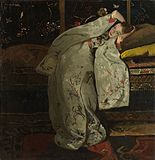
- ^ "George Hendrik Breitner – Girl in White Kimono". Rijksmuseum, Amsterdam. Archived from the original on 9 September 2012. Retrieved 12 May 2012.
- Sources
- Breuer, Karin (2010). Japanesque: The Japanese Print in the Era of Impressionism. New York: Prestel Publishing.
- Cate, Phillip Dennis; Eidelberg, Martin; Johnston, William R.; Needham, Gerald; Weisberg, Gabriel P. (1975). Japonisme: Japanese Influence on French Art 1854–1910. Kent Country University Press.
- Earle, Joe (1999). Splendors of Meiji: treasures of regal Japan: masterpieces from the Khalili Collection. St. petersburg, Fla.: Broughton International Inc. ISBN1874780137. OCLC 42476594.
- Irvine, Gregory, ed. (2013). Japonisme and the ascension of the mod art movement: the arts of the Meiji period: the Khalili collection. New York: Thames & Hudson. ISBN978-0-500-23913-one. OCLC 853452453.
- Lambourne, Lionel (2005). Japonisme: cultural crossings between Japan and the Westward. New York: Phaidon.
- Ono, Ayako (2003). Japonisme in United kingdom: Whistler, Menpes, Henry, Hornel and nineteenth-century Japan. New York: Routledge Curzon.
- Slawson, David A. (1987). Secret Teachings in the Fine art of Japanese Gardens. New York/Tokyo: Kodansha.
- Thomson, Belinda (2014). "Japonisme in the Works of Van Gogh, Gauguin, Bernard and Anquetin". In Museum Folkwang (ed.). Monet, Gauguin, Van Gogh… Japanese Inspirations. Folkwang/Steidl.
Further reading [edit]
- Rümelin, Christian, and Ellis Tinios. The Japanese and French Print in the Era of Impressionism (2013)
- Scheyer, Ernst. "Far Eastern Art and French Impressionism," The Art Quarterly 6#two (Spring, 1943): 116–143.
- Weisberg, Gabriel P. "Reflecting on Japonisme: The State of the Subject field in the Visual Arts." Journal of Japonisme ane.1 (2016): three–16. online
- Weisberg, Gabriel P. and Yvonne M.L. Weisberg. Japonisme, An Annotated Bibliography (1990).
- Wichmann, Siegfried. Japonisme. The Japanese Influence on Western Art in the 19th and 20th Centuries (Harmony Books, 1981).
- Widar, Halen. Christopher Dresser. (1990).
- thesis: Edo impress art and its Western interpretations (PDF)
External links [edit]
 | Wikimedia Eatables has media related to Japonisme. |
- "Japonisme" from the Metropolitan Museum of Art Timeline of Art History
- "Orientalism, Absence, and Quick~Firing Guns:The Emergence of Nihon as a Western Text"
- "Japonisme: Exploration and Commemoration"
- Marc Maison's Gallery specialized in japonisme
- The Private Collection of Edgar Degas, fully digitized text from The Metropolitan Museum of Art libraries; contains essay Degas, Japanese Prints, and Japonisme (pgs 247–260)
Source: https://en.wikipedia.org/wiki/Japonisme

Post a Comment for "Term Describing the Influence of Japanese Art Fashion and Aesthetics on Western Culture?"